In This Guide
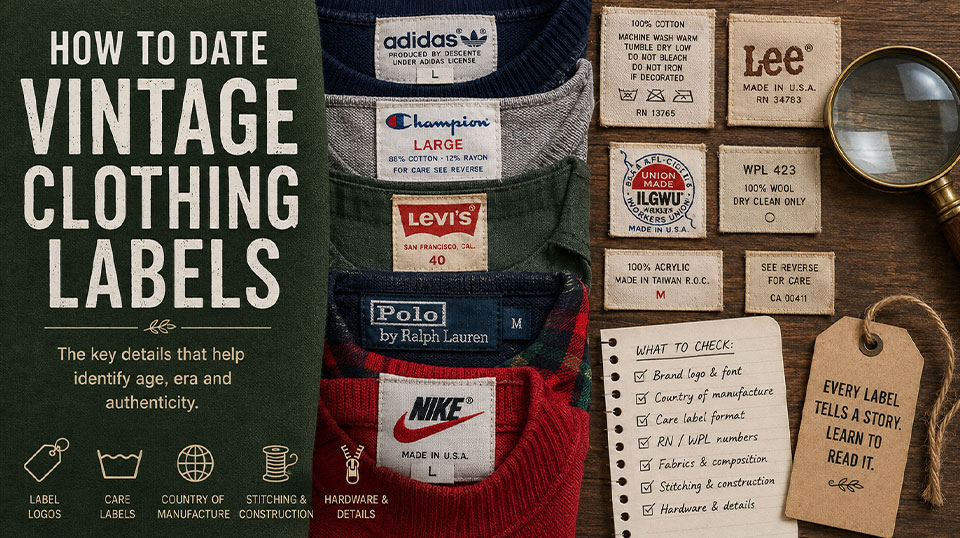
How to Date Vintage Clothing Labels
When you are trying to work out how old a piece of clothing is, the label is often one of the best places to start.
Vintage clothing labels can reveal clues about a garment’s age, manufacturer, country of origin, fabric composition and even the period in which a particular brand identity was being used.
But dating vintage clothing labels is not always as simple as finding one number and looking it up.
Brands changed their labels at different times. Garments were manufactured in different countries. Care-label requirements evolved. Logos were redesigned. And some modern clothing deliberately recreates the appearance of older labels.
At Already Made, we therefore treat the label as part of the evidence rather than absolute proof.
Here’s what to look for when trying to date a vintage clothing label.
Why Are Clothing Labels Useful for Dating Vintage?
Fashion brands rarely keep exactly the same label forever.
Over time they may change:
Logos
Fonts
Colours
Label materials
Wording
Country of manufacture
Sizing systems
Care instructions
Company names
Registered business information
If you can identify when a particular version of a label was being used, you may be able to narrow down when the garment was produced.
The strongest results come from combining the label with other evidence from the garment itself.
Think of vintage dating as detective work.
One clue helps.
Several matching clues are much better.
1. Start With the Main Brand Label
The most obvious place to begin is the label displaying the brand name.
Look carefully at the logo.
Compare its font, symbol, colours and layout with other known examples from the same brand.
Major fashion and sportswear companies often update their visual identity over time, sometimes making subtle changes that can help identify a period.
You may notice:
A different version of the logo
Older typography
A previous company name
Wording that is no longer used
An unusual label shape
A woven label rather than a printed one
Older colour combinations
Searching for genuine examples of the brand’s older labels can help you build an approximate timeline.
However, do not assume every unfamiliar logo is old.
Brands sometimes introduce heritage collections or reproduce previous logos on modern clothing.
Always look for supporting evidence.
2. Check the Care Label
The care label can sometimes be even more useful than the main brand label.
Look for information such as:
Washing instructions
Dry-cleaning instructions
Ironing guidance
Care symbols
Fibre composition
Country of manufacture
Manufacturer information
Product codes
The format and complexity of care labels have changed considerably over time.
Very old garments may contain little care information compared with modern clothing.
Later garments tend to carry more detailed instructions, fibre information and standardised symbols.
For US-made and US-market clothing in particular, care labels became much more significant after the Federal Trade Commission introduced its Care Labeling Rule in the early 1970s.
This means the presence, wording and style of a care label can help establish whether a garment is likely to come from before or after certain periods.
It should still be treated as one clue rather than an exact manufacturing date.
3. Look at the Country of Manufacture
Made in USA.
Made in England.
Made in France.
Made in Hong Kong.
Made in Taiwan.
Made in Portugal.
Country-of-origin labels can be extremely useful when researching vintage clothing.
Many brands moved their manufacturing between countries over time.
A company may have produced much of its clothing domestically during one period before moving manufacturing elsewhere in later decades.
If you can establish when a brand was producing a particular type of garment in a particular country, you may be able to narrow the date significantly.
But avoid oversimplified rules such as:
“Made in USA automatically means 1980s.”
It doesn’t.
Manufacturing histories vary enormously between brands.
Instead, ask:
Was this brand producing this type of garment in this country during the period I suspect?
That’s a much stronger approach.
4. Check for RN Numbers on American Clothing
If you collect American vintage clothing, you may encounter an RN number.
RN stands for Registered Identification Number.
These numbers are issued by the US Federal Trade Commission to businesses involved in manufacturing, importing, distributing or selling textile products.
An RN can therefore help identify the company responsible for putting the garment into the US market.
This can be extremely useful when the brand name on the garment differs from the underlying company.
However, there is an important warning:
An RN number is not the manufacturing date of the garment.
The same business can continue using its RN across many years and many different products.
Use the number to research the company behind the garment, then combine that information with other clues to estimate its age.
5. Look for WPL Numbers
Older American wool garments may sometimes carry a WPL number.
WPL refers to numbers historically issued to companies manufacturing wool products under US wool-labelling rules.
The Federal Trade Commission no longer issues new WPL numbers, although older ones may still appear and some remain in use.
Finding one can therefore be an interesting clue when investigating older American clothing.
As with RN numbers, though, the number should not be treated as a date printed onto the garment.
Research the company and then consider the rest of the clothing.
6. Examine the Fabric Composition Wording
The way fabrics are described can also provide clues.
Look for wording such as:
100% Cotton
Pure New Wool
Polyester/Cotton
Acrylic
Rayon
Nylon
Made from imported fabric
Certain fibres became especially popular during particular periods, while terminology and labelling conventions also changed.
The material itself can support what the label is telling you.
For example, if a supposedly old garment uses a fabric blend, care-label style and construction that all look significantly newer, it is worth questioning the claimed era.
Fabric composition works best as supporting evidence rather than a dating method on its own.
7. Look at the Size Label
Vintage sizing can provide another clue.
You may see size formats such as:
38
40
42
rather than Small, Medium and Large.
Women’s clothing may use numbered sizing that seems very different from today’s equivalent.
Older garments may also use separate labels for the size rather than incorporating everything onto one modern information tag.
But size is particularly unreliable as a dating method on its own.
Brands have always differed.
Sizing systems vary between countries.
And what counted as a Medium decades ago may fit very differently from today’s Medium.
Use size labels as another piece of the puzzle, not proof.
8. Look for Union Labels
Some vintage clothing — particularly garments manufactured in the United States — may include union labels.
These can be useful because union names and label designs changed over time.
Collectors sometimes use particular designs from clothing-worker unions to estimate the period in which a garment could have been manufactured.
The important word is could.
Union labels can potentially give you a date range, but they should be researched carefully.
Look at:
Exact wording
Logo
Colours
Label shape
Union name
Country wording
Avoid identifying the period simply because you see the word “union”.
The precise design matters.
9. Look for Copyright or Trademark Dates
Graphic T-shirts, promotional clothing and licensed merchandise sometimes include copyright dates.
For example:
© 1994
That looks like an easy answer.
Unfortunately, it is not always that simple.
A copyright date usually relates to the artwork, character, logo or intellectual property.
It does not necessarily mean the garment itself was manufactured in that year.
A design copyrighted in 1994 could theoretically be reproduced years later.
Copyright dates are still extremely useful clues, particularly when combined with the garment’s label and construction.
But think:
“No earlier than…”
rather than automatically:
“Made in…”
10. Look at How Much Information Is on the Label
Modern clothing labels often contain a huge amount of information.
You may find:
Multiple languages
Detailed washing symbols
Website addresses
Product codes
Style numbers
Barcodes
QR codes
Recycling information
Extensive fibre descriptions
Older labels are frequently simpler.
That does not mean every simple label is vintage, but a very modern information format can quickly reveal that an apparently vintage-looking piece is actually recent.
A QR code inside a supposedly 1980s sweatshirt would clearly be a warning sign.
11. Check for Website Addresses
This is one of the quickest ways to identify some modern reproductions.
If the label contains something like:
you immediately know the garment cannot predate the widespread commercial use of the web.
It might still be old enough to qualify as vintage today, but it clearly cannot be an original 1970s or early 1980s garment.
Small modern details like this are sometimes more useful than the large logo on the front.
12. Look at the Label Material
The physical construction of the label itself can provide clues.
Vintage labels may be:
Woven
Embroidered
Satin-like
Cotton
Printed
Paper-like
Sewn on all four sides
Attached only along the top edge
Compare this with known examples from the brand.
Many modern labels use completely different materials and printing techniques from older versions.
You may even find that the label has naturally faded or softened alongside the garment.
Again, artificial ageing exists, so condition alone is never proof.
13. Look for Multiple Labels
Do not stop after looking at the neck label.
Check everywhere.
Useful information might appear:
Inside the side seam
Near the waistband
Inside a pocket
Behind the main label
At the bottom hem
Inside the lining
Sometimes the main brand label looks convincingly old while a secondary care label reveals much more information about when the garment was actually made.
When dating vintage clothing, every label matters.
14. Compare Labels With Known Examples
One of the most effective ways to date a vintage clothing label is comparison.
If you believe a sweatshirt is from the 1990s, search for authenticated or well-documented pieces from that brand during the same decade.
Compare:
Logo → font → label colour → country → material → care label → stitching
You are looking for patterns.
If numerous verified garments from roughly the same period carry an almost identical label, your confidence increases.
If the label appears only on obviously modern pieces, you may need to reconsider your estimate.
15. Don’t Date the Garment From the Label Alone
This is the most important rule.
Imagine a label appears to match examples from the 1990s.
Now check the garment.
Does the stitching make sense?
Does the fabric?
Does the fit?
Does the hardware?
Does the graphic style?
Does the wear appear natural?
Does the country of manufacture fit the brand’s history?
When all of those clues tell roughly the same story, you can be far more confident.
When they contradict each other, investigate further.
Can Vintage Labels Be Fake?
Yes.
As vintage clothing has become more desirable, reproductions and counterfeit pieces have become increasingly relevant.
Some garments deliberately reproduce:
Old logos
Vintage-style labels
Faded graphics
Retro packaging
Historic branding
This does not automatically mean the garment is counterfeit.
A legitimate brand may release a heritage or reproduction collection using its own historical designs.
But it does mean:
An old-looking label does not automatically equal an old garment.
Look at everything.
What If the Label Has Been Removed?
Missing labels are common in vintage clothing.
Previous owners may have cut them out because they were uncomfortable.
Labels can become damaged.
Stitching may fail.
Or the garment may originally have had only minimal labelling.
A missing label makes dating harder, but not impossible.
You can still investigate:
Stitching
Construction
Fabric
Hardware
Graphic style
Fit
Buttons
Zips
Manufacturing techniques
Sometimes the garment itself tells you more than the label would have.
How Accurate Can You Be When Dating Vintage Labels?
It depends on the piece.
Sometimes you may identify an extremely narrow period because a particular label was only used briefly.
Other times the best answer may simply be:
1980s
Early to mid-1990s
Late 1990s
Late 1990s / early 2000s
There is nothing wrong with a date range.
In fact, a careful estimate is better than false precision.
If there is not enough evidence to claim that a jacket was made in 1993, don’t claim it.
Estimated 1990s is much more useful than pretending certainty.
A Simple Vintage Label Dating Checklist
When examining a vintage clothing label, look at:
Brand logo
Typeface
Label design
Country of manufacture
Care instructions
Care symbols
Fibre composition
RN or WPL information where applicable
Union labels where applicable
Sizing format
Copyright information
Website addresses
Product codes
Label construction
Secondary labels
Then compare what you find with the garment itself.
The more clues that agree, the stronger your estimate becomes.
How Already Made Dates Vintage Clothing
At Already Made, we prefer evidence over guesswork.
When sourcing a vintage garment, we may examine its branding, labels, country of manufacture, care information, fabric, stitching, construction, hardware and overall fit.
Sometimes those details allow us to identify a fairly specific period.
Sometimes they don’t.
When the evidence supports an approximate period rather than an exact year, we describe the item accordingly.
You may therefore see terms such as:
Estimated 1990s
or:
Estimated late 1990s / early 2000s
We think that is better than inventing a history that the garment cannot prove.
Every vintage piece has a past.
Part of the fun is working out what that past might be.
Made Once. Worn Again.
Learning how to date vintage clothing labels becomes easier the more garments you examine.
Eventually, small details begin to stand out.
An old logo.
An unfamiliar care tag.
A manufacturing country you don’t normally see.
A different size format.
A woven label you’ve seen before.
Individually, these clues may tell you very little.
Together, they can reveal when and where a garment began its life.
And decades later, that same garment can still have another chapter ahead of it.
WEAR ALREADY MADE.
Made once. Worn again.